Events
-
-
Inter department football match on 28 August 2022: ISRT versus Department of Mathematics
We are delighted to let you know that our second match in the inter-department football tournament 2022 will take place tomorrow (Sunday, 28 August 2022) at 5:00 pm at the central field of the university. This time the opponent is the Department of Mathematics.
-
-
Seminar on “The Impact of Food Insecurity on Health Status, Suicidal Ideation and Quality of Life Among Adults Living in Poverty: A Study in Urban Slums of Bangladesh”
Title: The Impact of Food Insecurity on Health Status, Suicidal Ideation and Quality of Life Among Adults Living in Poverty: A Study in Urban Slums of Bangladesh Abstract: Food insecurity is an ongoing public health issue in developing countries, including Bangladesh, exacerbated by the ongoing COVID-19 pandemic. It has considerable health impacts on the
-
-

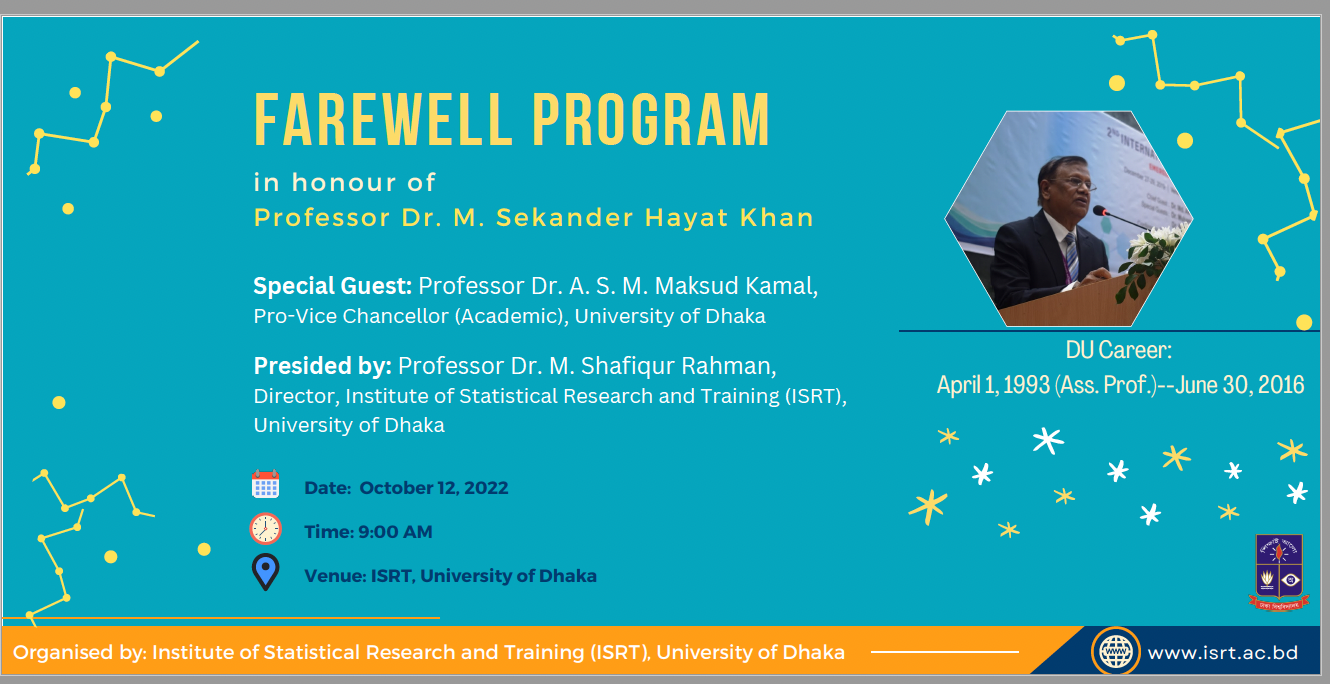
A farewell program for Prof. Dr. Sekandar Hayat Khan
ISRT Seminar Room (3rd floor) Institute of Statistical Research and Training, University of Dhaka, Dhaka, Please Select, BangladeshA farewell program for Prof. Dr. Sekandar Hayat Khan sir will be held at 9.00 am tomorrow (Wednesday, Oct 12, 2022) in the ISRT Seminar Room. Prof. Dr. A.S.M. Maksud Kamal, Pro-Vice-Chancellor (Academic), will join the event as the chief guest. You are cordially invited to join the program.
-

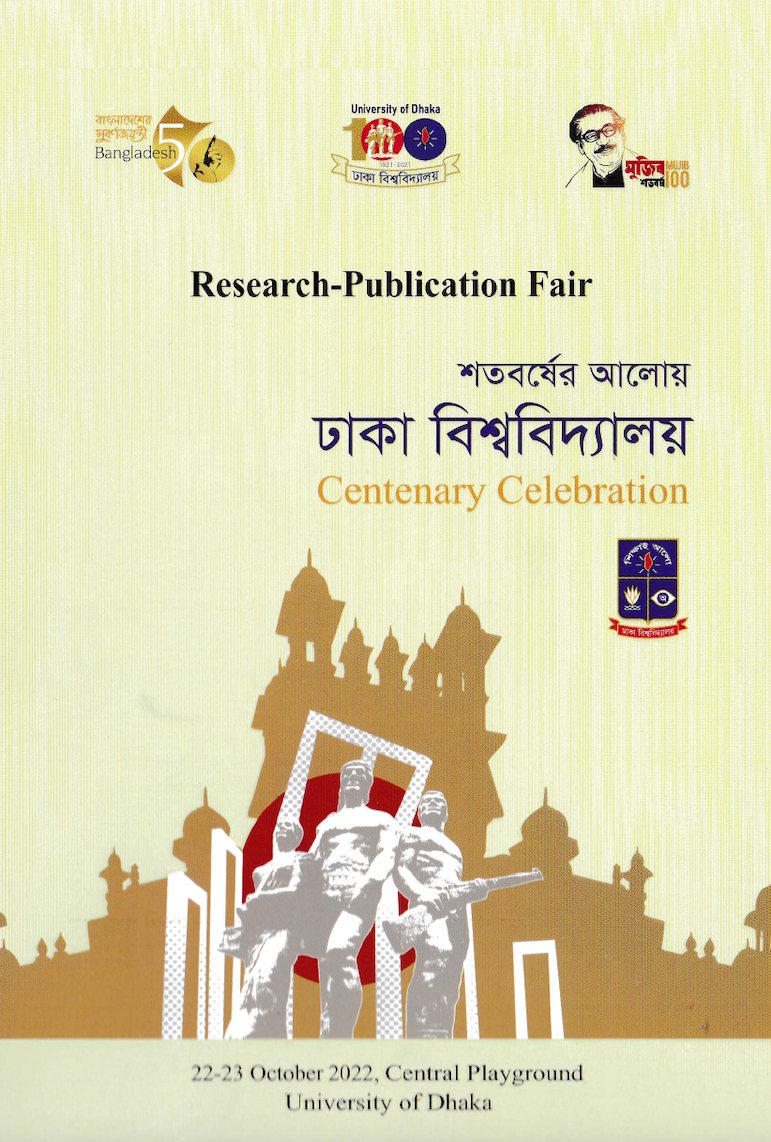
Research and Publication Fair on October 22-23, 2022
Playing Ground DUResearch and Publication Fair scheduled to be held during October 22-23, 2022.
-
ISRT Applied Statistics Seminar on October 25 (Tuesday) at 2:00 PM
ISRT Seminar Room (3rd floor) Institute of Statistical Research and Training, University of Dhaka, Dhaka, Please Select, BangladeshAn "ISRT Applied Statistics Seminar" on October 25 (Tuesday) at 2:00 PM (Venue: ISRT Seminar Room). Mrs. Tasnim Ara will talk on "Explaining geo-spatial variation in mobile phone ownership among rural women of Bangladesh: A multi-level and multidimensional approach." Mrs. Tasnim Ara is a lecturer at the Institute of Statistical Research and Training (ISRT), University of Dhaka. Further details about her talk are attached.
-
ISRT Seminar Room (3rd floor) Institute of Statistical Research and Training, University of Dhaka, Dhaka, Please Select, Bangladesh
An "ISRT Applied Statistics Seminar" on October 25 (Tuesday) at 2:00 PM (Venue: ISRT Seminar Room). Mrs. Tasnim Ara will talk on "Explaining geo-spatial variation in mobile phone ownership among rural women of Bangladesh: A multi-level and multidimensional approach". Mrs. Tasnim Ara is a lecturer at the Institute of Statistical Research and Training (ISRT), University of Dhaka.
-
-
ISRT Applied Statistics Seminar on November 1 (Tuesday) at 2:00PM on “Foundational Learning Skills of Children in Bangladesh: What We Learned from MICS”
ISRT Seminar Room (3rd floor) Institute of Statistical Research and Training, University of Dhaka, Dhaka, Please Select, BangladeshDr. Mohaimen Mansur will give a talk on "Foundational Learning Skills of Children in Bangladesh: What We Learned from MICS". Dr. Mansur is an Associate Professor at the Institute of Statistical Research and Training (ISRT), University of Dhaka.
-
-
Seminar on Subgroup Analysis with Differential Treatment Effects and Biomarker Identification at 2 pm on December 6, 2022
ISRT Seminar Room (3rd floor) Institute of Statistical Research and Training, University of Dhaka, Dhaka, Please Select, BangladeshTitle: Subgroup Analysis with Differential Treatment Effects and Biomarker Identification Abstract: In the process of drug development and regulatory decision making, it is important to characterize heterogeneity of subject response to treatment. The heterogenous effect is typically assessed based on variety of information on clinical, gene and protein expression markers, commonly known as biomarkers. Previous studies
-

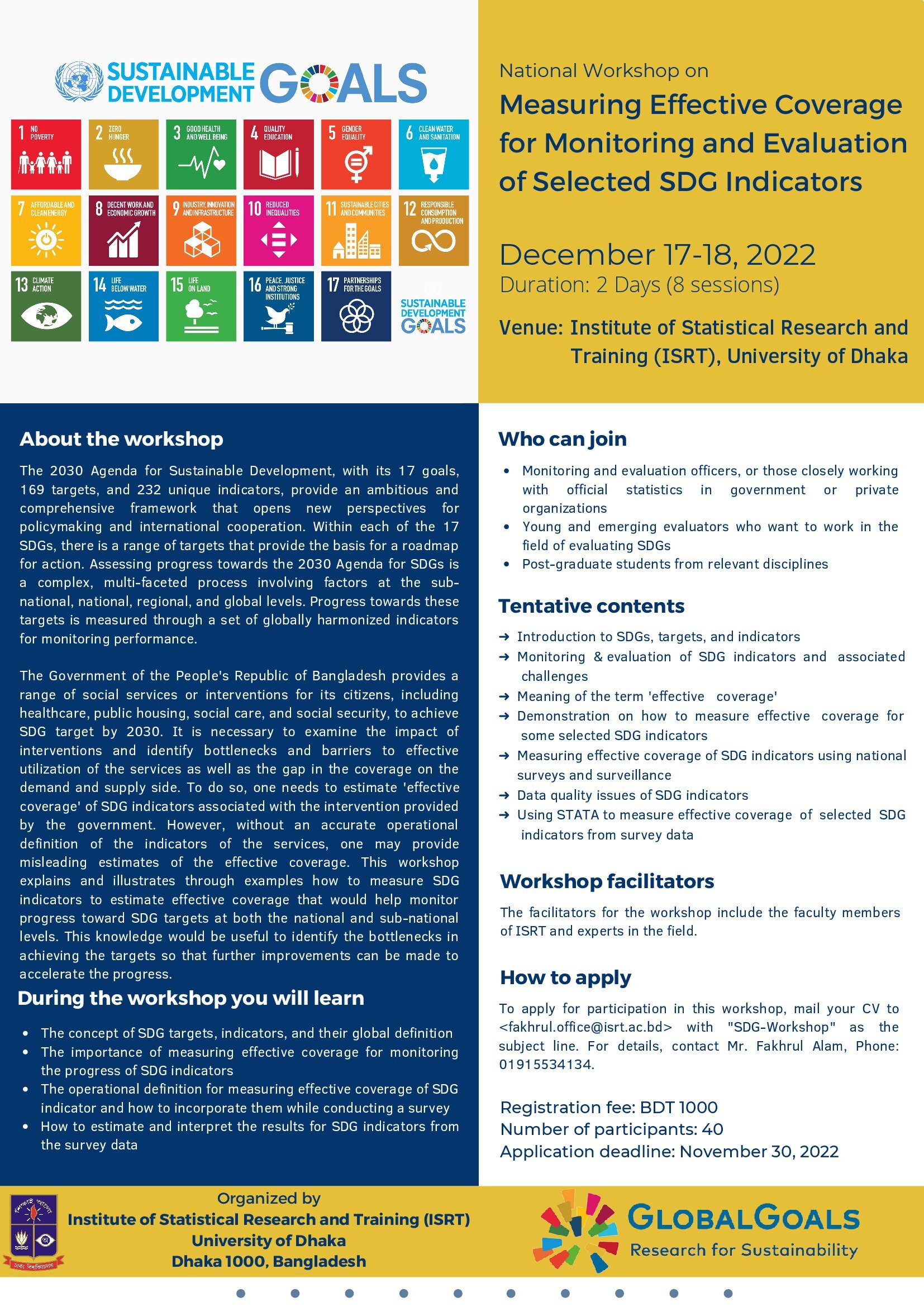
Workshop on Measuring Effective Coverage for Monitoring and Evaluation of Selected SDG Indicators on December 17-18, 2022
A national workshop on Measuring Effective Coverage for Monitoring and Evaluation of Selected SDG Indicators to be held on December 17-18, 2022, at the Institute of Statistical Research and Training (ISRT), University of Dhaka, Dhaka 1000, Bangladesh. For details, see the flyer and https://www.isrt.ac.bd/workshop.
-
Seminar on “Anomaly Detection in Temporal Networks through Topological Features and Motifs with Application to Mobility Data” at 2 pm on December 20, 2022
ISRT Seminar Room (3rd floor) Institute of Statistical Research and Training, University of Dhaka, Dhaka, Please Select, BangladeshSpeaker: Dr. Asim Kumer Dey, Brac University Venue: ISRT seminar room Date and time: 2 pm on Tuesday, 20 December 2022 Title: Anomaly Detection in Temporal Networks through Topological Features and Motifs with Application to Mobility Data Abstract: This paper aims to shed light on the potential relations among various higher-order network topological features and meso-level functionality of temporal