- This event has passed.
| Full Title: | Public Hurricane Loss Evaluation Models: Predicting Losses of Residential Structures in the State of Florida |
| Speaker: | B. M. Golam Kibria, PhD |
| Department of Mathematics and Statistics Florida International University Miami, FL 33199, USA |
|
| Date/Time: | Wednesday, December 8, 2010, 1150 |
| Venue: | ISRT Seminar Room |
As an environmental phenomenon, hurricanes cause significant property damage and loss of life in coastal areas almost every year. Although a number of commercial loss projection models have been developed to predict the property losses, only a handful of studies are available in the public domain to predict damage for hurricane prone areas. The State of Florida has developed an open, public model for the purpose of probabilistic assessment of risk to insured residential property associated with wind damage from hurricanes. The model comprises of the atmospheric science, engineering and actuarial components. The atmospheric component includes modeling the track and intensity life cycle of each simulated hurricane within the Florida threat area. Based on historical hurricane statistics, thousands of storms are
simulated allowing determination of the wind risk for all residential zip code locations in Florida. The wind risk information is then provided to the engineering and actuarial components to model damage and average annual loss, respectively. The actuarial team finds the county wise loss and the total loss for the entire state of Florida. The computer center compiles all information from atmospheric science, engineering and actuarial components, processes all hurricane related data and completes the project. The model was submitted to the Florida Commission on Hurricane Loss Projection Methodology for approval and went through a rigorous review and was revised per the suggestions of the commission . The final model was was approved for use by the insurance companies in Florida by the commission on August 17, 2007.
At every stage of the process, statistical procedures were used to model various parameters and validate the model. This paper presents a brief summary of the main components of the model (meteorology, vulnerability and actuarial) and then focuses on the statistical validation of the same.

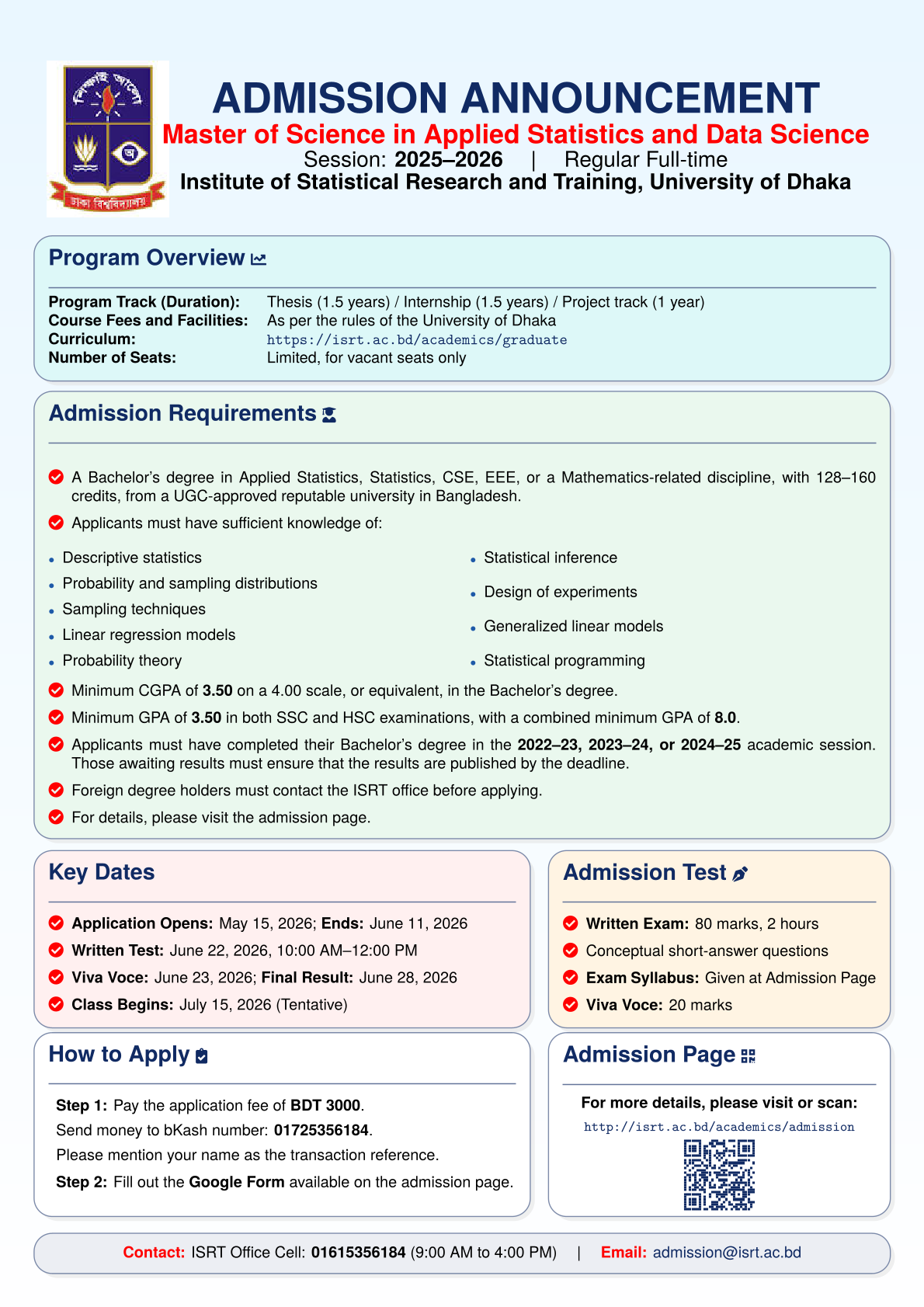
The Institute of Statistical Research and Training (ISRT), University of Dhaka, has extended the application deadline for admission to its MSc in Applied Statistics and Data Science (Regular Full-time) program ... [ Read More ]
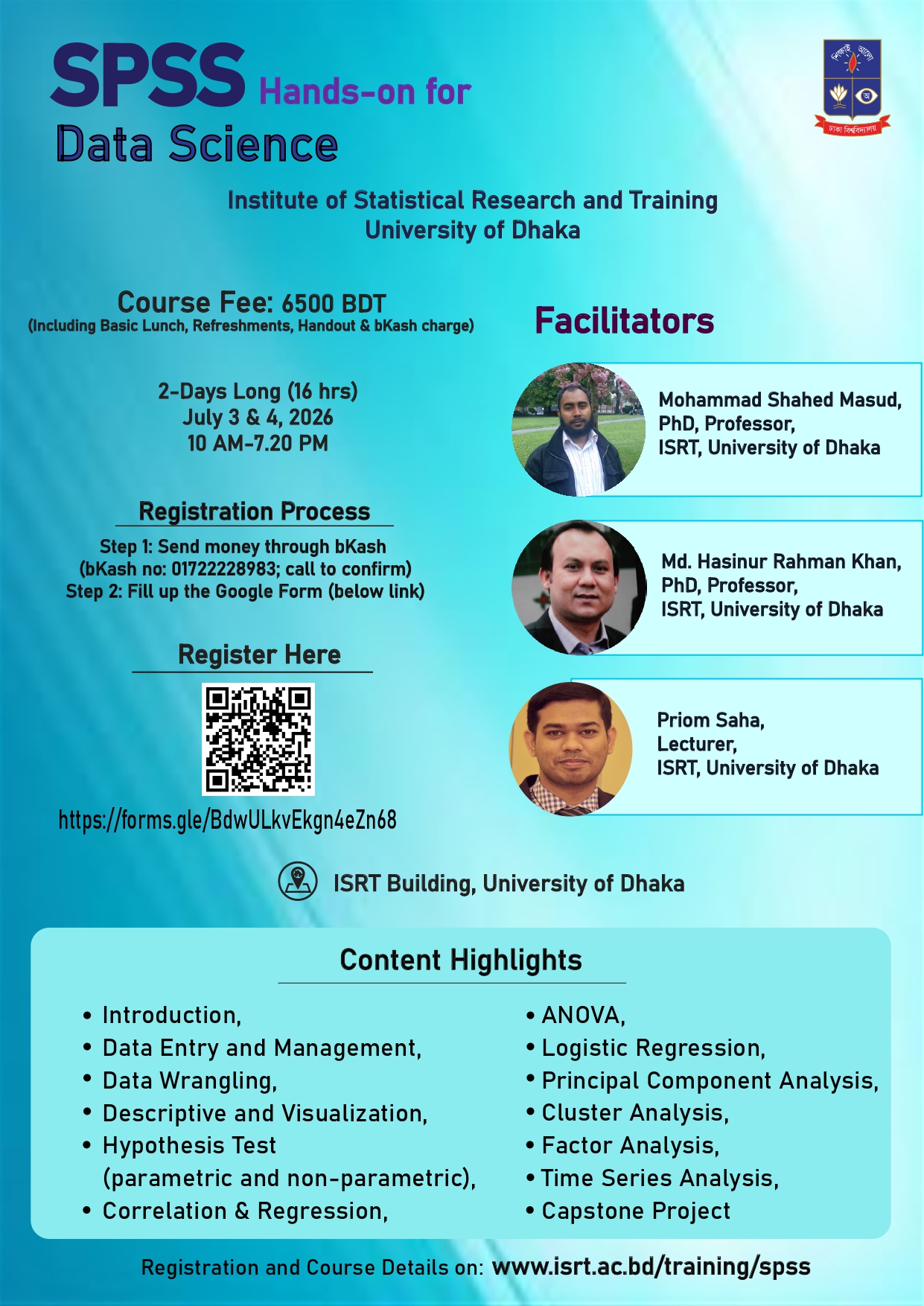
The Institute of Statistical Research and Training (ISRT), University of Dhaka, is pleased to announce a two-day intensive training course titled “SPSS Hands-on for Data Science”, designed to provide participants ... [ Read More ]
The Institute of Statistical Research and Training (ISRT), University of Dhaka, is pleased to announce admissions for the Master of Science in Applied Statistics and Data Science program for the ... [ Read More ]

The Institute of Statistical Research and Training (ISRT), University of Dhaka, proudly congratulates ISRT Batch-25 graduate Kamrun Naher Koli on receiving the Shamsun Nahar Mahmud Foundation Merit Scholarship awarded by ... [ Read More ]

The Institute of Statistical Research and Training (ISRT) recently hosted a farewell gathering in honor of Tasnim Ara as she embarks on a new academic journey to pursue higher studies ... [ Read More ]
Director,
Institute of Applied Statistics
and Data Science (IASDS)
University of Dhaka
Dhaka 1000, Bangladesh